Accessibility Tools

Skip to main content

Author: Marina Muhlfriedel

Students Practicing Tai Chi & Qigong

What to Expect at a Tai Chi Summer Retreat

Whether you’re new to tai chi, have taken classes for a few years, or are a dedicated lifelong practitioner, you can deepen your practice this summer while relaxing at a warm, welcoming Tai Chi Foundation retreat.

Enjoy some truly special you-time with a stress-free week of tai chi, qigong, meditation, and other engaging activities led by exceptional TCF teachers.

Click here to explore TCF’s three inviting retreats in the U.S. and Ireland for 2026.

Wondering what to expect when you arrive? Keep reading!

Reflections from Last Year’s US East Coast Summer Retreat


The Tai Chi Foundation’s 50th Anniversary summer retreat season began in June at the beautiful Smith College campus in historic Northampton, Massachusetts, and I was delighted to be a part of it. There were 85 of us with all levels of experience gathering for a week of calming and enriching tai chi, qigong, and meditation sessions, along with special evening programs. The retreat was entitled “Nurture and Grow with Tai Chi,” which perfectly captured its essence for me.

As my tai chi practice deepened during the retreat, I met many people in person whom I had previously known only virtually on Zoom. I made new friends and, for the first time in a while, didn’t even think about opening my laptop for days! Although I attended a TCF retreat in Cheltenham, England, in 2023, this was my first US TCF Retreat. While it had its own distinct characteristics, I was pleased to recognize an underlying continuity in the teaching and opportunities for participation across the programming.

Hosted by Blue Ridge Tai Chi of Virginia, the retreat took place from June 7 to 13, with the first two days dedicated to meetings and training sessions for senior teachers and apprentices. We, students, arrived on the afternoon of June 8, and I spent a couple of hours exploring Northampton, with its charming stores and cafes, before checking in and settling into my dorm room, distant memories of my college years flooding back.

I loved my view of the park-like campus, stately buildings, and the more modern student center named for celebrated alumna Julia Child. After dinner, everyone attended an orientation session that gave us a sense of what was ahead. I was excited, but still on West Coast time, the thought of getting up for optional morning rounds at 6:45 am was initially a little daunting. As the week progressed, though, I grew to appreciate the opportunity to open and close each day, practicing with the larger community.

Although last year’s East Coast retreat took place at the Hotchkiss School, many participants had previously attended TCF programs at Smith College. They were able to help us newcomers navigate scenic walks to various class locations. The pleasant weather, with occasional drizzles, kept the atmosphere comfortable throughout.

After our early form rounds and breakfast, we came together each day for a helpful class on tai chi principles, taught by various senior teachers who underscored key tenets of our practice. Next, everyone attended their respective form or push hands classes. I was enrolled in an Intermediate Form taught by Sherry Kent, Anna Teeples, and Fran Snyder. I loved the incredible knowledge and intuitive support they provided. Each of the 10 hours I spent with them and my classmates opened new layers of understanding and refinement of the form. It was an extraordinary time of abstract concepts becoming tangible.

Morning classes were followed by seated relaxation and meditation or advanced push hands sessions. Afternoons were filled with more form work, push hands, qigong, and sword form. In the late afternoons, participants could experience Hawaiian swimming classes or take a break. I knew I would need some time to myself, so I passed on the swimming, but I hope to try it one of these years! Instead, during my free time, I visited Smith’s lovely art museum, botanical garden, and greenhouse, which offered pleasant diversions throughout the week.

After dinner, evening programs led by senior teachers invited us to discover different aspects of tai chi and the Tai Chi Foundation. On Monday, Margaret Olmsted and others led a 50th anniversary exploration of what makes TCF the unique school it is. On Tuesday, Bob Etherington and his skeleton co-host guided us through a session on anatomy. Tina Curran and Hal Caswell conducted a poetry workshop on Wednesday, during which we all experimented with writing a few lines; then, those of us brave enough to read our poems aloud did so. On Thursday evening, Michael Braudy hosted “Sound and Health – A Meditative Experience.” We all enjoyed his beautiful violin playing as we vocalized the Indian ragas he taught us. Additional rounds of the tai chi form followed each evening’s program.

Alongside the Tai Chi Foundation retreat, a large group of musicians was on the Smith campus for Django in June, an annual music event where artists from around the world gather for Gypsy Jazz workshops, concerts, and jam sessions. Our two groups dined together, and on a couple of nights, tai chi retreat participants were able to enjoy the spirited live performances.

Friday marked our last evening together, and before our farewell party, we gathered in a large circle for a Treasure Chest — an opportunity for anyone who wanted to contribute the gifts they experienced during the week. It was heartwarming to hear everyone, from tai chi first-timers to senior teachers, express the many positive ways the week had impacted them. At my turn, I stumbled over my words, trying to succinctly sum up how much the retreat experience meant to me. I am shy by nature, and feeling welcomed into the TCF community and growing my tai chi meant a great deal to me. Gratitude for all the teaching, organizing, and inspiration that went into the retreat filled the room with exceptionally good vibes, leading to toasting one another, dancing, and plenty of laughter at the party.

Many thanks to everyone who organized this wonderful retreat and to all the teachers who taught form and push hands classes at Smith this summer.

Many thanks as well to everyone who attended the retreat and helped celebrate the 50th anniversary of the Tai Chi Foundation!


***
Explore More Tai Chi with TCF

You can learn more about tai chi by exploring the diverse offerings of the Tai Chi Foundation (TCF). TCF provides live online courses, allowing you to participate in guided sessions in the comfort of your home. These virtual classes offer unique opportunities to connect with experienced instructors, ensuring that you receive personalized guidance and feedback. Additionally, TCF offers Teachable on-demand classes, providing a flexible way to learn at your own pace. Whether you’re a beginner or an experienced practitioner, these online resources offer a wealth of knowledge to enrich your tai chi journey. For those seeking a more hands-on experience, check out the in-person course offerings of TCF’s affiliated local schools.

TCF is a not-for-profit educational organization that promotes, funds, and teaches programs that enable people to learn tai chi chuan and embody its principles.

Be sure to check out the TCF Shop, where you can find stylish tai chi t-shirts!


by Marina Muhlfriedel

Photos by Anna Teeples and Marina Muhlfriedel

Copyright Tai Chi Foundation 2025 and 2026

Apprentice Reflections with Vincent Zee in Götzens    


March 2026

After working with Vincent for the second time in Götzens, 14 apprentices from 7 different countries reflected with Vincent on how his classes affect them and our school. His workshop was then followed by the semi-annual weekend for local and international students.

                                                 Compiled in the order that was spoken by Maria Gandler and Sherry Kent


Question #1
What does the work with Vincent bring you? How does it enrich your or our tai chi? How does being here in Götzens, doing both Vincent’s classes and then teaching classes yourself on the weekend, enrich you?

In my daily life, I am listening more. By listening to myself more, I can also deal better with different people. I recently had a job change, and this work helped me to take this step.

– – – – – – – – – – – – – – – – – – – – – – – – – – – – – – – – – – – – – – – – – – – – – – – – – – – – – – – – – – – – – – – –

I am excited to walk on this path. Vincent’s work, together with Bill Palmer’s “Inner Qi Gong,” reconnected my core to tai chi and the richness in our schools.

I often rush to places. Today I left late again, but chose to slow down my pace and my breath thanks to Ian’s reminder, not rushing to the class, and yet I arrived in a timely manner!

– – – – – – – – – – – – – – – – – – – – – – – – – – – – – – – – – – – – – – – – – – – – – – – – – – – – – – – – – – – – – – – –

Practicing with Vincent and then teaching in the weekend, both continue my own learning — particularly the ongoing work of becoming more present, more patient, more attuned. The pathways in tai chi are infinite. There is no fixed destination to reach, no final level of mastery to achieve beyond what exists in this moment. The path itself is the goal. Being here and sharing this practice with others, reminds me of that truth.

– – – – – – – – – – – – – – – – – – – – – – – – – – – – – – – – – – – – – – – – – – – – – – – – – – – – – – – – – – – – – – – –

I know more of what is good for me. I feel more connected. The work brings me closer to becoming more and more sensitive. The inner work is hard and heavy, but the result is worthwhile and amazing. It is an experience I only get from doing it. ItÂŽs not the words but the feeling that helps the body relax and lets the energy sink.

– – – – – – – – – – – – – – – – – – – – – – – – – – – – – – – – – – – – – – – – – – – – – – – – – – – – – – – – – – – – – – – –

While being in touch through the three points of contact with the arms in one line, I am more able to listen and get a clearer image and feeling of the person from these three different perspectives.

With a soft touch, and by releasing everything down, even the little rotation in my hip joint  happens when I am moved by the active person.

When teaching students over the weekend together with fellow apprentice teachers, I felt a lightness, joy, and simplicity. The work with Vincent beforehand prepared us for this.

– – – – – – – – – – – – – – – – – – – – – – – – – – – – – – – – – – – – – – – – – – – – – – – – – – – – – – – – – – – – – – – –

This work has helped me see myself uncontrived, the depth of listening taught me to accept myself in the Now. It helped me in my healing process, and to respect myself and my boundaries. I took time to listen to myself and to deepen my connection with myself and the world around me.

– – – – – – – – – – – – – – – – – – – – – – – – – – – – – – – – – – – – – – – – – – – – – – – – – – – – – – – – – – – – – – – –

Vincent is a catalyst who brings a fresh way of looking and a renewal in the way we view tai chi and push hands. In his soft way, he catalyzes change in each of us and in our school.

In his classes, I don’t have any special function, so I can enjoy being a beginner and absorb what he has to offer
 a relief after years of feeling responsible. I already see the work he offers echoing through each of us and through our school. It has already begun.

Vincent offers a live example of how to listen to ourselves and to others in a kind way, responding gently instead of reacting from emotion.

We are all in the process of discovering ways to gently evolve our curriculum to include even more listening and softness.

– – – – – – – – – – – – – – – – – – – – – – – – – – – – – – – – – – – – – – – – – – – – – – – – – – – – – – – – – – – – – – – –

I am happy. I like to open up towards all. I like to play and share with all of you.

Vincent’s way of teaching seems to have a lighter tone.

– – – – – – – – – – – – – – – – – – – – – – – – – – – – – – – – – – – – – – – – – – – – – – – – – – – – – – – – – – – – – – – –

This work brings motivation for me to do more of the solo form with these new aspects. It gives us impulses of what more we can do for ourselves.

I often read in the books of Cheng Man Ching regarding the phrase “dead meat”.  Now I understand the meaning of it. “The tai chi cake we are eating is getting bigger and growing.”

– – – – – – – – – – – – – – – – – – – – – – – – – – – – – – – – – – – – – – – – – – – – – – – – – – – – – – – – – – – – – – – –

Vincent shows us that letting go of our ego, leads to softness.

I often felt alone in my tai chi studies. Now, I feel, I have found a “native speaker.”

Now I am understanding the books and the “Master tapes”.

Also, watching the sword with Cheng Man Ching – it is like a wave. It is about relaxing and listening. I am going along with the process. I am working little pieces of the form to work more in depth.

The teacher arrives when you are ready for it. I am glad to experience with each other, being in the process of dropping our egos. This is a nice environment. It is like a relief for me.

I have to listen, and it will come.

– – – – – – – – – – – – – – – – – – – – – – – – – – – – – – – – – – – – – – – – – – – – – – – – – – – – – – – – – – – – – – – –

I have been into tai chi over 25 years. I integrate tai chi more and more in my practice as massage therapist/osteopath. Able to be like a mirror and also receive genuine feedback.

I ask myself: how do I work with people who are not on this “plane”?

I allow myself to make mistakes.

– – – – – – – – – – – – – – – – – – – – – – – – – – – – – – – – – – – – – – – – – – – – – – – – – – – – – – – – – – – – – – – –

The work with Vincent brought me back to daily practice, and it also brought back my joy for tai chi.

– – – – – – – – – – – – – – – – – – – – – – – – – – – – – – – – – – – – – – – – – – – – – – – – – – – – – – – – – – – – – – – –

Tai chi helps me to be clear. In my work, I experience that colleagues enjoy when I am clear. If I am clear, the situation is clear as well. Tai chi helps me to be grounded in any situation.

– – – – – – – – – – – – – – – – – – – – – – – – – – – – – – – – – – – – – – – – – – – – – – – – – – – – – – – – – – – – – – – – 

Question #2
How do Vincent’s classes enrich our international tai chi school?

I believe that it is not a coincidence that Vincent appeared in a time of transformation and transition in our international school. It is about unity and love.

– – – – – – – – – – – – – – – – – – – – – – – – – – – – – – – – – – – – – – – – – – – – – – – – – – – – – – – – – – – – – – – –

His classes are like a breath of fresh air, like opening the windows in spring and letting the air flow through the house. He voices and shows things in slightly different ways, which enables each of us to hear familiar teachings anew and to question our assumptions about how tai chi should be practiced and taught.

The gift of this happening now is that it brings openness to new possibilities for change, without the need to fight for it or become rebellious. It allows change to happen more naturally. And tai chi itself is about change.

We have inherited certain patterns of behavior in our school. I would love us to grow away from blaming others and toward greater self-responsibility, becoming more able to recognize and respect everyone’s worth with kindness. Vincent’s own openness and personal development offer us an example.

– – – – – – – – – – – – – – – – – – – – – – – – – – – – – – – – – – – – – – – – – – – – – – – – – – – – – – – – – – – – – – – –

My guess is that all of us will grow to embody the tai chi principles, the embodiment in our form, and also in our mind and spirit. I’ve got the feeling that Vincent’s inspiring influence will bring practice and principles together in a gentle, soft & loving way.

– – – – – – – – – – – – – – – – – – – – – – – – – – – – – – – – – – – – – – – – – – – – – – – – – – – – – – – – – – – – – – – –

Less and less ego, equal in person, different in mastery and experience.

– – – – – – – – – – – – – – – – – – – – – – – – – – – – – – – – – – – – – – – – – – – – – – – – – – – – – – – – – – – – – – – –

Fellowship – we learn from each other. We need each other to bring out our best potential. It enriches everyone. It is a win/win situation. What you give, you get back. Reciprocity.

– – – – – – – – – – – – – – – – – – – – – – – – – – – – – – – – – – – – – – – – – – – – – – – – – – – – – – – – – – – – – – – –

This is bottom-up change. As people go further in the work, that makes change. Do the work, let it filter. We do not know where the work will go. It deepens our connection.

– – – – – – – – – – – – – – – – – – – – – – – – – – – – – – – – – – – – – – – – – – – – – – – – – – – – – – – – – – – – – – – –

However well tai chi was embraced from the beginning, now it feels like a shift towards a further opening in our school, part of a healthy ongoing evolution.

I also believe it is not a coincidence that Vincent appeared in our school. Good timing. A shift is happening, and we can align with and trust its unfolding.

– – – – – – – – – – – – – – – – – – – – – – – – – – – – – – – – – – – – – – – – – – – – – – – – – – – – – – – – – – – – – – – –

We have all heard these things, and this is another perspective on it.

– – – – – – – – – – – – – – – – – – – – – – – – – – – – – – – – – – – – – – – – – – – – – – – – – – – – – – – – – – – – – – – –

There is something powerful that happens when practitioners from many different places come together. This program creates a collective permission — a shared openness — to explore new depths of the practice and experiment with new ways of learning. What may have once felt structured or bound begins to release, and tension, whether in the body, the practice, or between people, can be released.

With seven countries represented here, that opening carries real weight. The local school plays a vital role in facilitating this cross-pollination of ideas — bringing diverse perspectives into conversation with one another in a way that helps reconnect some of the lost elements of Professor CMC’s lineage. It is a reminder that tai chi transcends borders, and that this school holds a space wide enough for all of it.

– – – – – – – – – – – – – – – – – – – – – – – – – – – – – – – – – – – – – – – – – – – – – – – – – – – – – – – – – – – – – – – –

I appreciate the martial art aspect.

– – – – – – – – – – – – – – – – – – – – – – – – – – – – – – – – – – – – – – – – – – – – – – – – – – – – – – – – – – – – – – – –

Generally, ego has diminished. The work provides a reflection of ourselves and allows us to change.

The single focus exercises help us pay close attention.

Years ago, a friend advised me, “Take a large bowl of warm water and put both your elbows in it and sit in front of a mirror.” I asked why would you want to do that. She said, “If you do this exercise, you are not going anywhere and have to take the time to look into the mirror and see yourself. Take the time to let go of self-criticism, accepting yourself as you are now, with love. This opens a door towards transformation.”

– – – – – – – – – – – – – – – – – – – – – – – – – – – – – – – – – – – – – – – – – – – – – – – – – – – – – – – – – – – – – – – –

It is like a reset for the school where we all start learning together, no matter the number of years of experience and level. It is a huge opportunity.

– – – – – – – – – – – – – – – – – – – – – – – – – – – – – – – – – – – – – – – – – – – – – – – – – – – – – – – – – – – – – – – –

Thanks to Harm Leerling, as he had the first contact with Vincent, working with him by himself, and then started groups to work with Vincent in Amsterdam.

Photography: Mike Boner

Welcome to April’s 50th Anniversary Blog: Margaret “MO” Olmsted, Gerrie Sporken, and Greg Woodson


Margaret “MO” Olmsted                             Greg Woodson                                           Gerrie Sporken
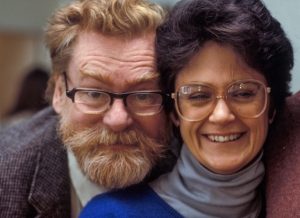
 

In honor of the Tai Chi Foundation’s 50 years, each month in 2025, we are publishing blog posts featuring historical material, reflections by TCF tai chi teachers, videos, and photos. We hope the images and words will connect the tai chi community to our school’s many strengths, expand our understanding of the art, and inspire our practice. And who knows? Perhaps something in this series will inspire you to share your experience as well; the door is always open. Welcome to this month’s edition:

Living Tai Chi

Fifty years later, Margaret, Gerrie, and Greg share their tai chi journeys, since TCF’s earliest days. 

***


Margaret Olmsted has been teaching with the Tai Chi Foundation (TCF) since 1976. Recognized as a Legacy Holder, which is the top tier of teaching, she works to ensure the quality of education. Margaret (also known as MO) supports the TCF on various committees. She lives and teaches in Los Angeles.


Gerrie Sporken discovered tai chi in 1976 and became deeply passionate about the practice, a devotion that continues to this day. Trained by Patrick Watson, a senior student of the renowned Prof. Cheng Man-ch’ing, she began teaching in 1977 through the School of T’ai Chi Chuan (now T’ai Chi Foundation), sharing the art in Amsterdam, England, Ireland, Austria, and the USA. Integrating tai chi into her acupuncture practice, she’s used its movements to support healing, such as helping those with limited mobility by focusing on the tan tien to cultivate strength and improve circulation. Alongside Pat Gorman, she developed the Roots & Branches program, blending tai chi with the Five Elements theory to harmonize Qi with elemental energies. As a senior teacher, she offers tailored classes in tai chi and Roots & Branches Qi Gong, adapting to seasons or specific groups.


Greg Woodson has been a senior faculty member for the T’ai Chi Foundation/School of T’ai Chi Chuan since the late 1980’s offering seminars, training workshops and group trainings with other participating teachers throughout the tai chi community in the US, Europe and Latin America. Greg began his study of the martial arts in 1969 and has been an active tai chi teacher under the auspices of Patrick Watson’s School of T’ai Chi Chuan since 1976. Greg has a deep and abiding love for tai chi and is always seeking opportunities to share its value with all people, novices and enthusiasts alike.


***

Join MO and Gerrie as they retrace spiritual journeys that began in their early 20s and continue today.

My Spiritual Journey with Tai Chi and Arica
By Margaret Olmsted

MO and Patrick Watson, 1984

As we enter our 50th year as a tai chi school, I am inspired to look back at how I started my spiritual journey. In 1974, at age 23, I traveled to Cholula, Mexico, to hook up with a cute guy I met at a friend’s wedding. Unfortunately, he came down with Hepatitis and was unable to hang out. So, I traveled around with others I met on the road — it was the 70s, and we were all hippies. I met another cute guy and his friends with a VW bus, and we drove around Mexico together for a while. At one point, we spent the night at a campground and, the next morning, went looking for magic mushrooms that grew out of cow patties in a wet, foggy field.

Success! We took our bagful and headed into the mountains to a place called Agua Azul, which had milky blue cascading waters. We camped out and ate the mushrooms, and within a short time, my perception of reality altered. My awareness expanded — colors were brighter, the sun felt warmer, and the air was magical. My kinesthetic sense heightened. My heart felt open. There was a feeling of almost understanding everything, and then it was gone. But I remember thinking: There’s something else going on, another level of awareness and understanding.

At the same time, I was reading Center of the Cyclone by John Lilly in which he describes his spiritual journey. When I got back to New York City, where I lived in my brother’s elegant brownstone, I finished the book. One section was about John Lilly’s experience in Chile with Oscar Ichazo, who founded the Arica Institute in 1972. I was determined to find something like he described: a community of people meditating together for the purpose of the transcendence of the ordinary. Remarkably, I opened an issue of the Village Voice, and there was a quarter-page ad for Arica announcing an introductory Open House program. I was amazed and delighted!

Click here to read the entire story

***

49 Years of Tai Chi Chuan
by Gerrie Sporken

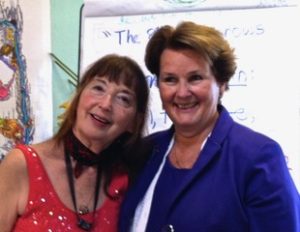
Gerrie Sporken (right) with Patty Gorman

It all started in the hot summer of 1976, when Paul van Loenen visited my boyfriend Thom and I. Paul arrived with a mission to invite us to an Arica program called the 9 Hypergnostic SystemsTM. That visit would change my life. The next morning, Paul did the first third of the tai chi form for us. I was mesmerized, and I wanted to learn tai chi.

Thom and I decided to go the Arica training in Dorset, UK, and we got the money together to pay for the six-week program. There were about 50 young-to-middle-age people from all kinds of lifestyles. I was kind of green, and when the training was opened in the name of God, I had flashbacks of my Catholic upbringing. I had sworn to never engage with another religion. The trainers were weird in my eyes. Happily for me, Arica turned out not to be a religion but a systematic program to assess your life in all its details, combined with physical exercises, breathing and meditations.

In the last two weeks of the program, Greg Woodson and Stan Swartz came to join us and taught us the first third of the tai chi form. While I thought I would easily learn the moves, it turned out to be harder than I imagined. After one class, I had to lie down because I was shaking from exhaustion. Greg and Stan did not say much at all in class, except that Greg kept whispering in my ear to come to New York to participate in the apprentice teacher program and learn to teach tai chi.

Click here to read  about Gerrie’s Life with Arica and Tai Chi

November 1984 

STCC faclilty, November 1984

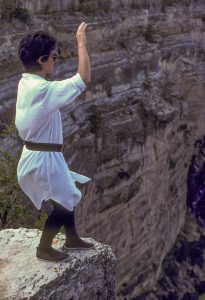
MO Standing on the Edge of the Cliff, Grand Canyon Sept 1989 Margaret Olmsted’s Spiritual Journey


In 1991, TCF leaders were affectionately known as “The Gang of Eight.” Left to right: Gerrie Sporken, Greg Woodson, Peggy Watson, Sherry Kent, Margaret Matsumoto, Margaret Olmsted, Axel Scholow, Patty Gorman.


As we celebrate 50 years, our school is now led by a Legacy Advisory Committee —pictured here in 2024. Left to right: Els Eijssens – Legacy Advisory Committee facilitator, Margaret Olmsted – Legacy Holder, Greg Woodson – Legacy Holder, Gerrie Sporken – Legacy Holder, Sherry Kent – Legacy Holder, Vanessa Costigan – Legacy Advisory Committee Member, Jonathan Stow – Legacy Advisory Committee Member, Margaret Matsumoto – Legacy Holder.

***
First Discovering Tai Chi and the Tai Chi Foundation?

You can learn more about tai chi by exploring the diverse offerings of the Tai Chi Foundation (TCF). TCF provides live online courses, allowing you to participate in guided sessions in the comfort of your home. These virtual classes offer unique opportunities to connect with experienced instructors, ensuring that you receive personalized guidance and feedback. Additionally, the Tai Chi Foundation offers Teachable on-demand classes, providing a flexible and accessible way to learn at your own pace. Whether you’re a beginner or an experienced practitioner, these online resources offer a wealth of knowledge to enrich your tai chi journey. For those seeking a more hands-on experience, check out the regular course offerings of TCF’s affiliated local schools.

TCF is a not-for-profit educational organization that promotes, funds, and teaches programs that enable people to learn tai chi chuan and embody its principles.

Be sure to check out our new TCF 50th Anniversary Shop, where you can find stylish tai chi t-shirts and other great branded merchandise!


The Tai Chi Foundation Editorial Team

Photos courtesy Tai Chi Foundation Inc.

Copyright Tai Chi Foundation 2025


50th Anniversary Logo

The Hidden Strength of Tendons and Ligaments

Using Slow Movement Practices Like Qigong and Tai Chi to Support Resilient Connective Tissue

By Anna Teeples

A Personal Discovery

For years, I dealt with recurring hip bursitis — the kind that sent me back to the doctor each year for a steroid shot just to keep moving comfortably. I tried strengthening my muscles, stretching more, resting more. Nothing stuck.

Then I began integrating qigong and tai chi into my routine. Slowly, something changed. The flare-ups became less frequent, then nearly disappeared. I no longer needed those shots. It wasn’t magic — but these gentle, mindful practices were giving my connective tissues the consistent, low-level care they had always needed and never received.

That experience sent me down a rabbit hole of research into the tissues we rarely talk about: our tendons and ligaments. What I found surprised me, and I think it might surprise you, too.

Why Tendons and Ligaments Matter

For many years, I thought strength meant muscles. Nearly every article about health and aging emphasizes strength training: strong legs, strong arms, a strong core. But the longer I study movement, the more I realize that some of the most important structures in the body are the ones we rarely talk about — our tendons and ligaments.

These unsung connective tissues link everything together. They stabilize our joints, transmit force through the body, and help us move with balance and coordination. When they are healthy, movement feels effortless. When they are not, we feel stiffness, instability, or pain. As we age, caring for these tissues becomes one of the most important things we can do.

The Body’s Quiet Support Network: Tendons and Ligaments

What Are Tendons and Ligaments?

Tendons connect muscles to bones, transmitting the force created by muscles so that joints can move. Think of tendons as biological springs. As you walk or climb stairs, they stretch slightly to store energy, then release it to help propel the next movement.

Ligaments connect bones to other bones, helping stabilize joints and guide their movement so they don’t twist or bend too far in the wrong direction.

Both are made primarily of strong collagen fibers, giving them the ability to withstand tension while still allowing a small amount of flexibility. Together, tendons and ligaments form an essential support network that enables coordinated, stable movement throughout the body.

The Suspension Bridge Analogy

Understanding how these tissues work can be easier with a simple analogy. One way to think about tendons and ligaments is to imagine a suspension bridge. The roadway carries the traffic, but it isn’t what makes the bridge strong. The real strength comes from the cables and supports that distribute forces throughout the structure.

Suspension Bridge: Golden Gate in San Francisco

In a suspension bridge, the cables tighten and release slightly as forces move through the structure — much like a spring. In the body, muscles generate movement, while tendons act like cables and ligaments like stabilizers. They transmit force, support the joints, and keep everything aligned. When these connective tissues are healthy, movement feels stable and efficient. When they weaken, the entire system becomes less resilient.

Three Common Myths About Tendons and Ligaments
Myth 1: Tendons and ligaments are basically the same thing.

These two tissues are often confused, but they play very different roles. Tendons connect muscle to bone, transmitting force that creates movement. Ligaments connect bone to bone, helping stabilize joints and guide safe motion. Think of ligaments as the body’s stabilizing straps, keeping joints aligned and preventing excessive movement.


Myth 2: Stretching makes tendons longer.

When we stretch, the tissues that respond most are muscles and the surrounding connective fascia — not the tendon itself. Tendons are designed to be relatively stiff so they can efficiently transmit force from muscle to bone. Tendon health improves most through slow, controlled loading and strength work, not passive stretching.


Myth 3: Tendons get strong as quickly as muscles.

Muscles often respond to exercise within a few weeks, but tendons adapt much more slowly. Research suggests meaningful tendon changes can take 8–12 weeks or longer. This slower adaptation is one reason sudden increases in activity can lead to tendon injuries. Tendons thrive on consistent, gradual training over time.

How Tendons and Ligaments Vary from Person to Person

Individual differences in connective tissue and joint structure also affect how our bodies move. Part of this reflects the natural anatomy we’re born with, while part evolves through how we move and train throughout our lives. When performing a deep squat, the ankle must bend forward while the heel stays on the ground. If the calf muscles and Achilles tendon do not lengthen enough, the body compensates by lifting the heel. This is why some people naturally squat with their heels down while others cannot — and neither is doing it “wrong.” These kinds of differences show how connective tissues reflect both natural anatomy and long-term movement patterns—one reason slow, consistent practices can gradually improve how the body moves.

We’ve all met someone who seems “double-jointed,” able to bend their thumb or elbow farther than most people. This usually reflects differences in ligament flexibility that allow greater joint range of motion.

One remarkable fact: the Achilles tendon can experience forces up to 6–8 times your body weight during running or jumping. Despite being only about the thickness of a finger, this tendon functions like an incredibly strong biological cable, transmitting force between the calf muscles and the heel bone.

Qigong and Tendon Conditioning

Many qigong practices emphasize slow, sustained positions. Practitioners often spend time in standing postures, gently expanding the arms, or holding positions through the legs while maintaining relaxed structural alignment. Although these movements appear quiet and effortless from the outside, they create a subtle but continuous tension through the body’s connective tissue chains.

This kind of low-level, sustained loading — what researchers call “isometric tension” (the tissue is under gentle stress without movement) — can be highly beneficial for tendons and ligaments. Over time, it encourages gradual adaptation, supports collagen rebuilding, improves joint stability, and builds endurance in the connective tissues that support our movements.

One way to think about this: qigong slowly strengthens the body’s internal “cable system.” Rather than relying on great muscular effort, the practice encourages the connective tissues to participate more fully in supporting posture and movement.

Tai Chi and Dynamic Tendon Loading

Tai chi, while also slow and controlled, tends to rely more on continuous movement rather than static holding. The practice involves shifting weight from one leg to the other, rotating through the hips and spine, and moving the arms in coordinated patterns that connect the entire body.

This creates a different type of stimulus for the tendons. Instead of sustained tension, tai chi repeatedly loads and unloads the connective tissues through movement. Tendons stretch slightly during these transitions and then recoil as the movement continues — training them to function more like springs, storing and releasing energy with each step.

This dynamic loading can improve movement efficiency, enhance balance responses, and help coordinate force transmission through the body’s connective tissue network.

The Key Difference

If you’re wondering which practice might suit you, here’s a simple way to think about the difference:

Practice Tendon Training Style
Qigong Sustained loading (gentle isometric tension — tissue under stress without movement)
Tai Chi Elastic loading (dynamic spring action — tissues stretch and recoil through movement)


In practice, both approaches complement one another. Qigong helps develop sustained structural support through the connective tissues, while tai chi trains those tissues to transmit and recycle energy through movement. Together, they provide a balanced approach to maintaining resilient tendons and ligaments over time.

What the Research Tells Us

Research on tendon adaptation helps explain why slow, controlled loading can be beneficial for connective tissue health .A review by Bohm, Mersmann, and Arampatzis (2015) examined how human tendons respond to mechanical loading. Their findings showed that tendons are not passive structures — they can adapt and strengthen when exposed to consistent stress. Over time, appropriate loading can lead to improvements in tendon stiffness, structural organization of collagen fibers (the body’s way of rebuilding stronger tissue), and the tendon’s ability to transmit force more efficiently.

The review also highlighted that tendons respond best to slow, sustained loading rather than rapid or explosive movement. These changes occur gradually, often requiring several weeks or months of consistent practice — which is exactly the kind of regularity that a tai chi or qigong practice naturally builds.

Additional research summarized by Magnusson and Kjaer (2019) indicates that aging can affect tendon elasticity and collagen structure. However, connective tissues remain responsive to appropriate loading at any age, meaning consistent movement and gentle strengthening can help maintain tendon resilience well into later life.

Supporting Your Connective Tissues Beyond Movement

While movement is one of the most important ways to support tendon and ligament health, other lifestyle factors also play a role. Adequate protein, vitamin C, hydration, sleep, and good circulation all contribute to the body’s ability to maintain and repair connective tissues over time.

Tendons are remarkably durable structures, but because they receive less blood flow than muscles, they often require more time to recover from strain or injury. Consistent, moderate movement — especially the slow, controlled kind — is one of the most effective ways you can support them.

Closing Thoughts

Muscles may receive most of the attention when we talk about strength, but tendons and ligaments provide the hidden framework that allows our bodies to move efficiently and safely. By caring for these connective tissues through consistent movement, thoughtful training, and supportive lifestyle habits, we help maintain the resilience that supports us throughout life.

If you’ve been curious about qigong or tai chi, this might be the moment to explore. You don’t need special equipment, a high level of fitness, or prior experience. Just a willingness to move slowly, pay attention, and show up consistently. Your tendons and ligaments will thank you. By moving slowly, consistently, and with awareness, we give these often-overlooked tissues the care they need to keep us moving well for years to come.

Research References

Bohm, S., Mersmann, F., & Arampatzis, A. (2015). Human tendon adaptation in response to mechanical loading. Sports Medicine.

Magnusson, S. P., & Kjaer, M. (2019). Tendon properties in relation to muscular activity and aging. Scandinavian Journal of Medicine & Science in Sports, 29(4), 520–531.

***

Interested in learning more? We’d love to help you!

Discover your tai chi or qigong path with the Tai Chi Foundation (TCF). TCF provides live online courses, allowing you to engage in guided sessions in the comfort of your home. These virtual classes offer unique opportunities to connect with experienced instructors, ensuring that you receive personalized guidance and feedback. Additionally, the Tai Chi Foundation offers Teachable on-demand classes, providing a flexible and accessible way to learn at your own pace. Whether you’re a beginner or an experienced practitioner, these online resources present a wealth of knowledge to enhance your tai chi journey. For those seeking a more hands-on experience, be sure to check out the in-person course offerings of TCF’s affiliated local schools.

Be sure to check out the TCF Shop, where you can find our stylish signature tai chi t-shirts!

Stay inspired by keeping up on all our classes, retreats, and events. Sign up here for the TCF newsletter.

TCF is a not-for-profit educational organization that promotes, funds, and teaches programs that enable people to learn tai chi chuan and embody its principles.


© Tai Chi Foundation 2026

Golden Gate Bridge Photography by Josh Kahen on Unsplash


Qigong and Halfpipe Snowboarding: Tai Chi at the Olympics

By Peter Schwartz

Patrick Watson, the founder of our tai chi school, was fond of saying, “Whatever you do in life, tai chi can help you do it better.”

If you sing, tai chi can help you sing better. If you dance, tai chi can help you dance better. If you’re a mountain climber, tai chi can help you climb mountains better.

I’m not sure he would have applied this principle to writing novels or solving scientific mysteries, but he might well have.

Patrick’s earliest students found this principle to be true. And even new beginning students without much tai chi experience, who have never heard this principle, have discovered that tai chi markedly improves their lives in all kinds of ways.

They are more sure-footed when they rock climb. Conversations with their partners about difficult subjects have become easier. Their breathing is deeper and fuller. Their knees feel better than they have in years. Of course, not all tai chi practitioners report experiences like these, but many do.

Now, it seems, the U.S. Men’s Halfpipe Snowboard team discovered this principle for themselves by performing an ancient Chinese energy practice closely related to tai chi: qigong.

“I’ve been doing a bunch of qigong before riding this whole season,” says Chase Blackwell, from Longmont, Colorado, in one report. “Qigong is a form of meditation in motion. It gets me in the zone, calms the nerves a little bit, and gets me fired up to go send,” he says.

In fact, the whole team has been practicing qigong. Watch them doing the “tiger,” an exercise found in the Five Animal Frolics, one of the oldest forms of qigong (click here to view).

How does it work?

“You’re collecting the energy, harnessing that universal power,” team member Chase Josey says. “Then you can go out there and push your own body to extreme limits in the halfpipe, and ideally do it gracefully and smoothly and land on your feet.”

They’ve even got their coaches doing “cloud hands,” a sequence from the tai chi form. “In moments of high pressure, you can block out the noise a little bit, just breathe.”

How did the team do? All three members advanced to the finals in 2026, reportedly one of the highest-level halfpipe contests in Olympic history.

Patrick Watson might have said, “I told you so.” *


* Patrick would also add that nothing helps improve your tai chi except more tai chi. He would point to stretching as an example. Yoga adepts have wonderfully stretched out muscles, but they’re hard when you squeeze them. Much the way a rubber band stretches when pulled, but is hard when pinched. Food for thought. What do you think?

***

Stay on your game with the Tai Chi Foundation 

Whether you’re a career athlete or a Monday night football fan, you can enhance your health and well-being by practicing tai chi and qigong.

Learn more by exploring the various offerings of the Tai Chi Foundation (TCF). TCF provides live online courses, allowing you to engage in guided sessions in the comfort of your home. These virtual classes offer unique opportunities to connect with experienced instructors, ensuring that you receive personalized guidance and feedback. Additionally, the Tai Chi Foundation offers Teachable on-demand classes, providing a flexible and accessible way to learn at your own pace. Whether you’re a beginner or an experienced practitioner, these online resources present a wealth of knowledge to enhance your tai chi journey. For those seeking a more hands-on experience, be sure to check out the in-person course offerings of TCF’s affiliated local schools.

Be sure to check out the TCF Shop, where you can find our stylish signature tai chi t-shirts!

Stay inspired by keeping up on all our classes, retreats, and events. Sign up here for the TCF newsletter.

TCF is a not-for-profit educational organization that promotes, funds, and teaches programs that enable people to learn tai chi chuan and embody its principles.


© Tai Chi Foundation 2026

Image by WOKANDAPIX on Pixabay


Tai Chi for Trauma Recovery


Many people are familiar with tai chi as a practice that supports general health and reduces stress. Less widely known is its potential role as a supportive practice for people recovering from trauma and post-traumatic stress disorder (PTSD). When taught with care and depth, tai chi can help restore a sense of safety, continuity, and connection with the body — all essential elements in trauma recovery.

What Is PTSD?

Post-traumatic stress disorder (PTSD) is a mental health condition that can develop after someone experiences or witnesses a traumatic event, such as violence, serious injury, natural disaster, or life-threatening situations. Symptoms may include:

  • Intrusive or distressing thoughts
  • Flashbacks or nightmares
  • Avoidance of trauma-related reminders
  • Heightened anxiety or hypervigilance
  • Difficulty sleeping or concentrating
  • Emotional numbness or detachment

These symptoms can persist long after the event and may significantly interfere with daily life and relationships.

Although PTSD is often associated with military veterans, anyone can develop PTSD. The National Center for Complementary and Integrative Health (NCCIH) reports that approximately 7–8 percent of people in the United States will experience PTSD at some point in their lives, with women affected at higher rates than men.

Clinical guidelines emphasize that evidence-based psychotherapy and, in some cases, medication are the primary treatments for PTSD and should be guided by licensed mental health professionals.

How Tai Chi Can Support Trauma Recovery

Research suggests that tai chi may serve as a valuable complementary practice when integrated with professional care in the treatment of PTSD. Often described as “moving meditation,” tai chi combines slow, continuous movement with breath awareness and focused attention — qualities that can be especially supportive for people recovering from trauma.

A review of mind-body practices published in Depression and Anxiety found that approaches such as tai chi, meditation, and yoga can reduce stress-related symptoms and emotional distress.

Nervous System Regulation

Trauma can disrupt the body’s ability to regulate stress. Mindful movement practices such as tai chi have been shown to support autonomic nervous system balance, encouraging calm, grounded awareness rather than reactivity.

Stability, Presence, and Continuity

Tai chi emphasizes softness, continuity, and attentive movement. These qualities can help practitioners reconnect with bodily sensations, improve concentration, and gradually build tolerance for internal experience—all important aspects of trauma recovery.

Emerging Research

Preliminary studies involving veterans with PTSD symptoms suggest that tai chi is well tolerated and may support calm focus and emotional regulation. These findings highlight tai chi’s feasibility and acceptability as a supportive practice, while underscoring the need for continued research.

Supporting Whole-Body Health

Chronic stress and trauma often affect physical health as well as mental well-being. Tai chi’s gentle, low-impact movements may help support the body in ways that indirectly aid emotional recovery, including:

  • Reduced musculoskeletal pain
  • Improved balance, strength, and coordination
  • Support for cardiovascular health
  • Improved sleep quality
  • Reduced inflammation associated with chronic stress

A systematic review published in BMC Complementary Medicine and Therapies found that tai chi practice is associated with improvements in psychological well-being and stress reduction.

A Thoughtful Complement to Healing

At the Tai Chi Foundation, tai chi is taught as a living practice rooted in lineage, presence, and embodied awareness. When approached with sensitivity and respect, it can offer a steady, non-invasive resource for people navigating trauma recovery.

Tai chi should never replace evidence-based treatment for PTSD, but it may serve as a meaningful complement when practiced with experienced teachers and alongside professional care. For authoritative information about PTSD symptoms and treatment options, visit the National Institute of Mental Health.

For those seeking a practice that supports calm, continuity, and embodied resilience, tai chi offers a path grounded in attentiveness and care—meeting people where they are and supporting healing over time.


***

Enhance Your Well-Being with the Tai Chi Foundation 

Whether you’re a healthy, active adult or facing physical or mental health challenges, you can enhance your quality of life by practicing tai chi and qigong.

Learn more about tai chi by exploring the various offerings of the Tai Chi Foundation (TCF). TCF provides live online courses, allowing you to engage in guided sessions in the comfort of your home. These virtual classes offer unique opportunities to connect with experienced instructors, ensuring that you receive personalized guidance and feedback. Additionally, the Tai Chi Foundation offers Teachable on-demand classes, providing a flexible and accessible way to learn at your own pace. Whether you’re a beginner or an experienced practitioner, these online resources present a wealth of knowledge to enhance your tai chi journey. For those seeking a more hands-on experience, be sure to check out the in-person course offerings of TCF’s affiliated local schools.

Be sure to check out the TCF Shop, where you can find our stylish signature tai chi t-shirts!

Stay inspired by staying current with all our classes, retreats, and events. Sign up here for the TCF newsletter.

TCF is a not-for-profit educational organization that promotes, funds, and teaches programs that enable people to learn tai chi chuan and embody its principles.

By JM Muhlfriedel

© Tai Chi Foundation 2026


Photography by Pixabay

The Eight Ways: Qigong or Tai Chi?

We recently received a question from a student in an Eight Ways of Tai Chi class asking whether the movements taught in the class are qigong or tai chi.

Qigong and tai chi are both Chinese mind-body practices combining movement, breathing, and meditation to improve health. Both have many different styles and teachers.

Qigong, which means “energy work,” is ancient. In 1971, a silk drawing of Daoist movements for health was found in a tomb dating to 168 BCE. Here’s a reproduction of that drawing, which I find charming.

Qigong uses simple, repeated short movements for cultivating energy and supporting health. Often, images are paired with the movements, which usually can be done in any order and may be designed to particularly affect a specific organ or body system. Qigong is an individual practice suitable for a range of abilities and is relatively easy to learn and practice. The TCF offers free online qigong classes called Five Element Qigong.

Tai chi means “supreme ultimate.” Legends suggest that it began with Zhang Sanfeng, a Daoist monk who lived sometime between 900 and 1300 CE. Written references to modern tai chi date from the 1820s CE. Rooted in Daoist philosophy, tai chi cultivates energy and supports health. It consists of long, flowing sequences of martial arts movements. Tai chi requires substantial time, memory, and practice to learn the form sequences. While the tai chi form is individual, tai chi also includes partner work called sensing hands. The Tai Chi Foundation offers online and live tai chi form classes in many cities in the US and Europe, and at our summer residential trainings.

Our Eight Ways class is qigong in that it involves individual repeated movements with images. Each of the movements is taken from the tai chi form. One unique aspect of this class is that each Way deepens movement principles that are specifically named and practiced, such as moving from your center, having a relaxed uprightness, and walking in balance. A second unique aspect of this class is that each Way is explicitly applied to enhance movements in daily life. Students learn to be at ease as they use their unified bodies to walk, sit, climb stairs, lift and move things, and carry items with stable balance.

The Eight Ways are great for those with impaired movement, for rehabilitation, and also for anyone who wants to deepen awareness of the tai chi principles of movement. See our Eight Ways Teachable program online to learn more, and stay tuned for live classes online or in your area.

By Edna Brandt

© Tai Chi Foundation 2026

***

Stay inspired by staying current with all of the Tai Chi Foundation’s classes, retreats, and events. Sign up here for the TCF newsletter.

TCF is a not-for-profit educational organization that promotes, funds, and teaches programs that enable people to learn tai chi chuan and embody its principles.

Spring – Up and Out!


By Joop Brouwer

The waiting is nearly over; from the cold, dark depths of winter, spring will follow. The seasons are the cycles of life, each with its own particular energetics, flavour, and quality, following the laws of nature.

According to Huangdi Neijing, the earliest existing Chinese medicine classic dating back over two thousand years, the three months of spring are a time for life to recover and spread. It is also a season for people to welcome life and revitalise their body and mind.

The ancient Chinese observed that each season is a manifestation of a particular energy. This energy, qi, is the underlying force of life, unfolding in nature and in our body, mind, and spirit. The qi in spring makes things grow; the ancients associated this with wood, as in spring, we see new life surging out of the stillness of winter. It is a time of birth and regeneration. Seeds thrust their way through the earth full of strength, first growing a root down, then shooting up to the light above. It has the power to penetrate through the soil and can grow around obstacles to find its way. There is also a new surge of life in the animal world – it is always a hopeful sight to see the new lambs jumping about in the green fields!

Although it is a great time to feel and be invigorated by it, the spirit of the wood qi is not only present during spring. Throughout the year, wood gives us the ability to start new projects, to grow, to be able to change and be flexible, to be assertive, to be creative, to have a sense of direction and vision, to connect with your uniqueness and your path in life, to be decisive, and to have a hopeful outlook for the future.

As the seed unfolds, it does so according to a predetermined plan, a blueprint, an inner purpose. To do that, it needs vigour, assertion, and determination. This is the energy you feel when you get fed up with the waiting in winter, and you want to get going. Perhaps we all can associate with being stuck in a traffic jam, that building up of energy, but not being able to do anything with it. The resulting frustration and anger will give us the energy to come up with a plan: “Shall we find another route? Can we get off at the next junction? Anything as long as we are moving — let’s decide now!” And yes, we do need that ‘up and go’ energy when starting a project or changing a plan. Too little of this appropriate anger will make us passive and timid, too much of it will result in overreacting and lashing out. Therefore, the ability to deal with change comes from the healthy wood qi within us.

A great way to strengthen our wood qi is to go out in nature, walk in a park, in the woods, or in the forest. Start a new project, make holiday plans, do something creative like painting or drawing, and practice tai chi and qigong!

Tai chi gives us that uprightness, being rooted in the earth below and in the heavens above. It helps us to relax, particularly releasing the tendons and ligaments, so our movements can become more flexible. Tai chi gives us a sense of direction, both on a vertical plane between heaven and earth and on a horizontal plane, on all sides of the compass, helping us know where we are and where we want to go. Learning tai chi can be challenging, but in this challenge lies the growing as new nerve connections and paths are created. In our tai chi and qigong, we can become creative and imaginative by becoming a tree, firmly rooted below through our feet, an upright body with our arms as flexible branches, and our fingers as leaves and buds searching for the light. If a storm blows, we will not be uprooted, but we will be able to move with the force without breaking.

Lao Tze, author of the Tao Te Ching (600 BC), reminds us of this:


The living are soft and supple;

the dead are rigid and stiff.

In life, plants are flexible and tender;

in death, they are brittle and dry.


Stiffness is thus a companion of death;

flexibility a companion of life.

An army that cannot yield

will be defeated.

A tree that cannot bend

will crack in the wind.


The hard and stiff will be broken.

The soft and supple will prevail.


Joop is a senior teacher with the Tai Chi Foundation and a practitioner and teacher of Five Element Acupuncture. He teaches with his wife, Lucy, in Lancaster (UK), and at various other TCF locations both in the UK and abroad.

***
Experience Tai Chi and Qigong Year-Round with the Tai Chi Foundation

You can learn more about tai chi by exploring the various offerings of the Tai Chi Foundation (TCF). TCF provides live online courses, allowing you to engage in guided sessions in the comfort of your home. These virtual classes offer unique opportunities to connect with experienced instructors, ensuring that you receive personalized guidance and feedback. Additionally, the Tai Chi Foundation offers Teachable on-demand classes, providing a flexible and accessible way to learn at your own pace. Whether you’re a beginner or an experienced practitioner, these online resources present a wealth of knowledge to enhance your tai chi journey. For those seeking a more hands-on experience, check out the regular course offerings of TCF’s affiliated local schools.

TCF is a not-for-profit educational organization that promotes, funds, and teaches programs that enable people to learn tai chi chuan and embody its principles.

Be sure to check out our TCF Shop, where you can find stylish tai chi t-shirts to show off your passion for tai chi!

© Tai Chi Foundation 2026

Photography: Charles Miller on Pexels

How to Create an Ideal Indoor Space for Tai Chi & Qigong Practice


Whether you practice at home alone, with others, or lead students in their daily rounds, creating a thoughtful indoor space can make tai chi safer, more comfortable, and more effective. Your environment plays an important role in supporting relaxation, balance, and continuity of movement. Consider creating a calm, uncluttered, distraction-free room to support your tai chi practice.

One of the many advantages of practicing tai chi is that it requires no special equipment and can be done indoors or outdoors. However, practicing indoors allows you to tailor your environment to your practice. Here are key elements to consider when setting up your personal indoor space.

Elements of an Ideal Indoor Space for Tai Chi
Small vs. large spaces.

Tai Chi space requirements can be flexible, depending on your needs, but ensure that the space is obstacle-free. An area as small as 3 x 4 feet can be used by individual tai chi or qigong practitioners, although a space of approximately 6 x 6 feet can more easily accommodate side-to-side steps and turns. An area of 10 x 15 feet (or larger) provides comfortable space for more natural, larger movements, a greater sense of flow, and room for more than one practitioner.

Using a computer for tai chi classes and videos.

Many tai chi classes, workshops, and videos are offered online. If you participate in these, having a computer screen in an easily viewable location is essential

A properly positioned computer screen should allow you to maintain a neutral neck posture and ensure clear visibility while standing. Position the top of the monitor at or slightly below eye level while standing in a natural, relaxed posture. If needed, use a height-adjustable monitor arm or a sturdy stack of books to elevate your device. Looking slightly downward (0–30 degrees) is preferable to looking up, which can cause neck strain.

Place the screen at least an arm’s length (about 20–30 inches) away. This distance allows you to see the instructor’s full movements without excessive head turning or squinting. Adjust the monitor to minimize reflections or glare that may hinder visibility.

Flooring

A smooth wood floor is ideal, but tai chi can be practiced on other smooth surfaces, such as tile or linoleum. Make sure your feet are protected (no loose nails, staples, or splinters, especially if you’re practicing barefoot), and there are no tripping or slipping hazards. Lightweight, flat-soled tai chi shoes enhance balance, stability, and connection to the ground and are preferred by many practitioners worldwide. Before beginning your practice, remove any loose mats or rugs from the floor, and ensure that the surface is neither too slippery (to avoid falls) nor too “grippy” (to prevent joint pain). Carpets are unsuitable for tai chi and should be avoided in your practice area.

Temperature control and air quality

 As with any physical activity, ensure your indoor space is neither too hot nor too cold so you can practice safely and comfortably. If you are allergic to dust, pets, or other environmental irritants, consider cleaning, temporarily shutting pets out, or using an air purifier. Because tai chi incorporates mindful breathing, good air quality is especially important.

Other considerations

Quiet, good ventilation, neutral relaxing colors, elements such as indoor plants, natural light, and loose, comfortable clothing that allows free movement of the hips, shoulders, and spine can be additional enhancements to your practice experience.

***
Create Tai Chi Space in Your Life with the Tai Chi Foundation 

Whether you’re new to tai chi and qigong or have a lifelong practice, you can enhance your quality of life by practicing tai chi and qigong with the Tai Chi Foundation (TCF).

TCF provides live online courses, allowing you to engage in guided sessions in the comfort of your home. These virtual classes offer unique opportunities to connect with experienced instructors, ensuring that you receive personalized guidance and feedback. Additionally, the Tai Chi Foundation offers Teachable on-demand classes, providing a flexible and accessible way to learn at your own pace.

Whether you’re a beginner or an experienced practitioner, these online resources present a wealth of knowledge to enhance your tai chi journey. For those seeking a more hands-on experience, be sure to check out the in-person course offerings of TCF’s affiliated local schools.

Be sure to check out the TCF Shop, where you can find our stylish signature tai chi t-shirts!

Stay inspired! Sign up here for the TCF newsletter to stay current with all our classes, retreats, and events.

TCF is a not-for-profit educational organization that promotes, funds, and teaches programs that enable people to learn tai chi chuan and embody its principles.


By JM Muhlfriedel

© Tai Chi Foundation 2026


Deep Roots, Living Shoots: Evolving Rooting, Aging

by Sherry Kent

Rooting can be misunderstood as only sinking low. While practicing and holding lower postures is a useful training method at certain stages of life, especially for younger practitioners with bodies that repair easily, how low you can go is not the definition of rooting. Rooting is a living relationship with the ground that can remain available throughout all the stages of life. Cheng Man-ch’ing emphasized that tai chi must remain practice-able into old age or it has missed its purpose. However, “how” you practice may be different at different ages.

My Reasons for Writing This

Since beginning tai chi practice, I have had knee issues. My teacher, Patrick Watson, told me these would pass, but they did not. I tried my best to be careful with knee and body alignment, yet my knees were not happy when doing tai chi. I listened to my teachers, consulted physical therapists and doctors, but was never able to find help that successfully addressed my knee issues.

Finally, in my 70s, after repeatedly experiencing how sinking low, holding positions and intensive tai chi adversely affects my knees, I decided to research the knees more deeply and relate this to my years of practice and understanding of tai chi. This article is the result. I sincerely hope it helps others respect the signals of their knees and bodies, and prevent or moderate future knee or other injuries.

What is Rooting?

True rooting includes the body’s capacity to receive and transmit force through the legs and feet into the ground, while remaining stable and responsive. Rooting is dynamic, not static. Once achieved, as tai chi classics describe, the energy is then free to travel back from the earth through open feet and legs, and governed by the waist can be expressed up and out through the hands.

Responsiveness Versus Depth

Responsiveness is an important measure of rootedness. If one cannot yield, neutralize, and be flexible when rooting, one is not rooted, regardless of stance depth.

Why Rooting is Not Necessarily the Same as Sinking Low

Sinking low is an external strategy, which can make stability and rooting easier to feel and is especially useful for supple younger bodies that recover quickly. As one gets older, however, excessive depth can compress and stiffen the knee, hip, and ankle joints, cause pain and reduce adaptability.

Cheng Man Ch’ing taught that stiffness and straining block the ability to root. Yang Chengfu’s oral teachings passed down the understanding: “sink the qi, not the weight.”1.

Many of us were trained through low postures and long holds, and the perspective I’m writing about here arises not in opposition to that training, but in service to our long-term continuity of practice. As we all know, over time, practitioners can refine external straightness to internal straightness. Consider that over time, practitioners can also refine external sinking to internal sinking.

Connection and the Arches of the Feet

Connection, through both the center of the arch of the foot and the Bubbling Well, is about relaxing naturally into an aligned structural support, and opening and connecting with the earth. I see the center of the arch of the foot as an important place for physical alignment and flexibility, and the Bubbling Well as enabling energetic connection. Both important.

For sure rooting is not about pressing weight downward or collapsing the arches of the feet. When weight is forced downwards, the joints of the foot can compress, and the arches can collapse, creating a physical “flat foot” condition. Our goal is not that the foot becomes so flat that the whole bottom of the foot touches the ground, as this would be recommending that we develop a flat foot condition, and we are not recommending that. When a person has the condition of flat feet, the arches in the foot have unfortunately been lost.

Rather, we want to keep the natural structural integrity of the arches of the feet, which help the foot’s ability to respond to changes of terrain. And we want to relax, center and distribute the weight over the whole foot (not tending towards the outside, inside, front or back).

When we relax the feet, they do open and spread to enable us to receive and center the weight, while also retaining the integrity and function of the arch. Retaining the arch of the foot is advantageous because the arch provides the keystone functions of both stability and flexibility. The feet remain springy, responsive, and buoyant while we connect deeply to the ground and root.

Channel Connecting Earth and Heaven

Cheng Man-ch’ing distinguishes true rooting from heaviness, or dead weight, suggesting that pressing the weight downward destroys liveliness, and can collapse the vital, alive integrity of the body and the capacity to move appropriately in response to any situation.

This is why lengthening the body, developing peng, and connecting to the heavens are also important. The upward lift towards heaven enables space creation… a lengthening of the spine, and opening the hip joints between the pelvis and leg bones, and actually all joints. All the joints need space to function optimally. If we maintain our structural integrity, relax while releasing our weight and muscles to open the qi energy flow within the body to connect deep into the earth, we also open a vertical channel that allows us to connect energetically and dynamically both up and down, connecting down to the gravity of earth and up to the levity of heaven. 

Rooting Evolves with Age

Nature has determined that our bodies change as we go through the different stages of life. The body and experience of youth is very different to that of a middle-aged person or of a senior. As our bodies age, and we hopefully become wise elders, physically the cartilage thins and the menisci stiffens, which means, for example, that the body’s tolerance for bending the knee decreases.

Research

In my research on this subject, sources from doctors and physiotherapists state that as one ages and certainly in the 70’s age group, if one has knee issues, a general reaccommodation is to limit deep sinking, squatting or sitting on the knees past more than 90° (or past 110° if a person is pain free, and well aligned) 2.  and of course there are always exceptions.

Even if one comes from a culture where people are used to squatting their whole lives, deep squatting remains mechanically challenging 3, increases joint stress, and can also contribute to the development of knee arthritis at older ages 4.

These findings support the idea that the bending range of the knees in tai chi should be approached with care and continuing awareness. As we age, we need to continue to move within our own range of movement and listen to and acknowledge the signals of the body. Then, hopefully, we prevent injury by not pushing deeper just because of tradition or habit.

Good News

The good news is that at the same time as we age, our experience and awareness of body alignment, and the sensitivity to internal energy pathways can actually increase.

The ability to achieve external depth may naturally diminish some, but internal connectivity can continue to be refined. This does not mean weaker rooting — it means rooting becomes more subtle and more precise. Rather than using external sinking as our guide, we can focus on internal rooting, connectivity, intention, deep listening, and the open flow of energy.

Consider

How we use the body and how we root both change as we age. The value of rooting in tai chi does not change with age, only its expression changes.

When we embrace the changing realities of physical aging with kindness and grace, and fully welcome the value of age-appropriate self-care of delicate tissues, rooting becomes less about achieving external sinking or lengthy holding of postures, and more about inner refinement, inner strength, softness, releasing, connecting, listening, and conscious direction of energy. This is the tai chi that allows rooting at any age.

Footnotes:

Sources compiled with digital research tools and independently reviewed by the author.

1. Taijiquan Ti Yong  Shu, The Essence and Applications of Taijiquan, Yang Chengfu. Yang Chengfu and Cheng Man-ch’ing on Tai Chi, edited by Stuart Alve Olson.

2. Multiple sources:

3. Age-related changes in kinematics of the knee joint during deep squat: https://pubmed.ncbi.nlm.nih.gov/21511482/.

4. Beijing OA Study, 2004: https://pubmed.ncbi.nlm.nih.gov/15077301/.

***

Discover Your Tai Chi and Qigong with the Tai Chi Foundation

You can learn more about tai chi by exploring the various offerings of the Tai Chi Foundation (TCF). TCF offers live online courses, allowing you to join guided sessions from the comfort of your home. These virtual classes offer unique opportunities to connect with experienced instructors, ensuring that you receive personalized guidance and feedback. Additionally, the Tai Chi Foundation offers Teachable on-demand classes, providing a flexible and accessible way to learn at your own pace. Whether you’re a beginner or an experienced practitioner, these online resources present a wealth of knowledge to enhance your tai chi journey. For those seeking a more hands-on experience, check out the regular course offerings of TCF’s affiliated local schools.

Click here to subscribe to our newsletter to stay up on all our classes, retreats, and events.

Be sure to check out our TCF Shop, where you can find stylish tai chi t-shirts!

TCF is a not-for-profit educational organization that promotes, funds, and teaches programs that enable people to learn tai chi chuan and embody its principles.

© Tai Chi Foundation 2026