Accessibility Tools

Skip to main content

Author: Marina Muhlfriedel

The 14th Annual West Coast Summer Tai Chi Retreat in Washington

by Margaret Olmsted
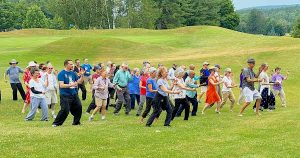
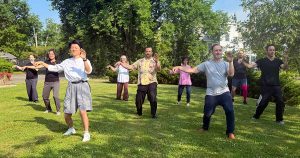
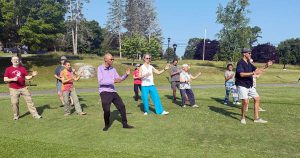
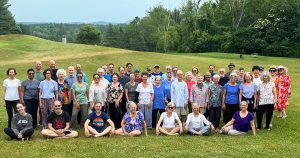
The 14th Annual West Coast Summer Tai Chi Retreat was held at the Whidbey Institute on Whidbey Island in Washington state on July 15-21, 2024, with 50 participants. Whidbey Island, once home to Lower Skagit, Swinomish, Suquamish, and Snohomish tribes, is a 20-minute ferry ride from Western Washington into Puget Sound, part of the Salish Sea.

With winding trails through the woods, a meditative labyrinth, a peaceful sanctuary, and two beautiful spaces for practicing tai chi, the grounds of the Whidbey Institute were ideal. Accommodations varied from camping under trees or on a wide lawn to a farmhouse with many cozy rooms and snug cabins.

The food, lovingly prepared by head chef Chrstyn Johnson, lead cook Gina Horrocks, and the other amazing kitchen staff, was, as always, extraordinary. Along with fresh, organic, produce-forward meals and vegetarian protein sources, they also included fish or chicken at each dinner. Mouthwatering desserts were also prepared for us. Needless to say, meals at the Whidbey Institute are one of the highlights of the day.

Jonathan Stow and Greg Woodson started us off in the mornings with Tai Chi Rounds and Push Hands before breakfast. Afterward, everyone gathered for Roots and Branches Five-Element Qigong, which Gerrie Sporken taught. It was fun to explore each element and generate qi together. The Five-Element class was followed by Paul Campbell leading us through Professor Cheng Man-ching’s teachings to bring us all to a deep internal state in our Tai Chi Form.  Next came Greg Woodson and Jonathan Stow’s class, where we delved into Tai Chi Principles to find deeper levels of relaxation and rootedness. Before lunch, we had Time in the Art sessions with varying focuses led by senior teachers Paul Campbell, David Goodell, Margaret Olmsted, Greg Woodson, and Jonathan Stow.
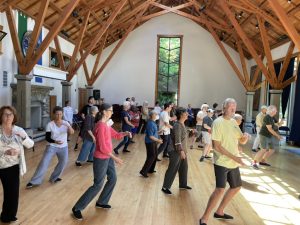
In the afternoons, Jonathan and Greg taught Advanced Sword and Fencing classes, while Gerrie Sporken led a Beginning Sword class. There is always more to learn and explore while wielding a sword. “The hilt leads the way” was commonly heard in the room, as was “the body moves the sword.”

Kate Mansfield and Vanessa Costigan continued the Tai Chi Principles work with those students who had not yet learned Sword Form.

In the late afternoons, David Goodell reviewed the third/third of the Tai Chi Form – B3 – which had more students every day as people were eager to refine their form. The rest of us relaxed, read, or napped.

After dinner, Paul Campbell led some participants through calming meditations from the Arica Institute. One evening, David Goodell’s student, Denis Janky, showed us wonderful examples of photographing the night sky called astrophotography. We were in awe. You can see examples of his work at www.deepskyguy.com.
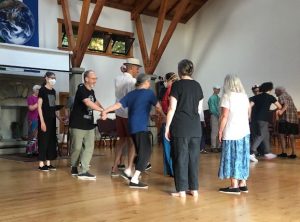
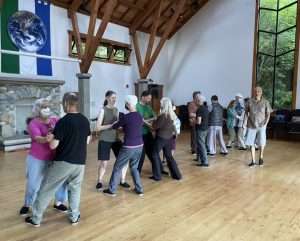
Square dancing turned out to be a particularly fun night! The caller did a great job of keeping us organized despite a lot of confusion and laughter. On the final night of the retreat, we had our traditional talent show, which included jokes, musical performances, poetry, a jewelry display, and a tribute song performed by a group of Seattle apprentices, followed by dancing and socializing.

Many thanks to all who contributed to the evening’s entertainment.

A heartfelt thanks to the teachers and participants who made this summer program such a huge success, including David Goodell and April Hulvershorn for organizing it, Host Will Noble, Co-Executive Director at the Whidbey Institute, Rose Woods, and all the other Whidbey Institute staff for making the retreat such a lovely and inspiring space to practice together.
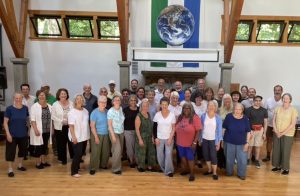
We hope to see you there next summer!

Photos by: Kate Mansfield and Margaret Olmsted

***

The Tai Chi Foundation (TCF) is a not-for-profit educational organization that promotes, funds, and teaches programs that enable people to learn tai chi chuan and embody its principles. Join us for a FREE Open House meeting to learn more about tai chi and qigong — and ways to get started with us!

Over 300 TCF-affiliated instructors teach tai chi classes in 30 cities worldwide. Check out our online course offerings. Discover in-person classes in your area and explore our on-demand Teachable courses. Sign up for our newsletter to receive updates on classes, workshops, retreats, and special events.

We invite you to become a member, and support TCF in making the world a healthier and more mindful place today!


A Fifth Season: Grounding and Harmony with the Late Summer Earth Element

As the intense heat of summer begins to wane, a new season subtly unfolds, one marked by the grounding and nourishing energy of the Earth element. This transitional period, referred to as “late summer,” is a term used in Traditional Chinese Medicine (TCM) to refer to a specific period in the seasonal cycle that is distinct from the conventional four seasons recognized in the Western calendar and lasts from mid-August until the fall equinox.

In TCM, the five seasons are each associated with one of five elements (Water, Wood, Fire, Earth, and Metal). Late summer, linked with the Earth element, invites us to connect with nature’s bounty and nourishing forces. Through the practice of tai chi and qigong, we can align ourselves with this powerful energy, enhancing balance and centering in our daily lives. Join me as I delve into the profound experience of embracing the Earth element during late summer through tai chi and qigong.

In this season, nature reaches a state of abundance. The fruits of our labor are harvested, and the earth generously offers its bounty. It embodies qualities of nourishment, stability, and balance and is a time to slow down, reflect, and integrate the year’s experiences thus far. Personally, practicing tai chi and qigong at this time deepens my relationship with the earth and helps me cultivate a sense of groundedness and inner peace.

Tai chi and qigong movements are designed to harmonize our energy with the natural world. Moving through the gentle, smooth, and fluid sequences, I feel a deep connection to the world beneath my feet. This connection to the earth provides a stability and calm that permeate my entire being. Each step and gesture become a meditation on balance and flow, helping me to center myself amidst the challenges and changes of everyday life.

The Earth element in late summer is about nurturing our physical, mental, emotional, and spiritual well-being. It is a time to care for ourselves, much like the earth nourishes the plants that grow upon it. Through tai chi and qigong, we can cultivate energy that supports our health and vitality. These practices encourage us to slow down, breathe deeply, seek peace, and move mindfully, fostering continuous relaxation and well-being.

This season also invites us to reflect on our personal growth and transformation. Just as the earth transforms seeds into mature plants, we, too, have the potential for significant self-observation, change, and development. Tai chi and qigong offer a framework for this inner work, providing tools to balance our energies and align with our highest values and selves, offering a pathway to unite with both the revealed and mystical elements of our existence. As we practice, we release tension, clear our minds, align ourselves with the rhythms of nature and the forces of the universe, become more attuned to the cycles of life, and approach our deeper purpose.

Doing tai chi and qigong in late summer is a meaningful way to embrace the Earth element and connect with its sustaining and stabilizing qualities. It is a time to reflect on our own personal harvest and abundance. Moving mindfully through our practice, we can carry a sense of balance, centering and quietude into all aspects of our lives.

The Tai Chi Foundation (TCF) provides free seasonal tunings five times a year to help our community align with the energy of the current season. Sign up today for the 2024 Late Summer Embrace the Earth tuning.

Explore the Tai Chi Foundation (TCF) ‘s diverse offerings to learn more about tai chi and qigong.

TCF offers live online courses, allowing you to participate in guided sessions from the comfort of your home. These virtual classes offer unique opportunities to connect with experienced instructors, ensuring that you receive personalized guidance and feedback, as well as Teachable on-demand classes, providing a flexible and accessible way to learn at your own pace. Whether you’re a beginner or an experienced practitioner, these online resources offer a wealth of knowledge to enrich your tai chi and qigong journey. For those seeking a more hands-on experience, check out the regular course offerings of TCF’s affiliated local schools.

TCF is a not-for-profit educational organization that promotes, funds, and teaches programs that enable people to learn tai chi chuan and embody its principles.

TCF’s mission is to improve health, well-being, and awareness through the study, practice, and teaching of tai chi and qigong by an increasing number of people worldwide. Sign up for our newsletter for updates on upcoming classes and events.

Over 200 TCF-affiliated instructors teach tai chi classes in 30 cities worldwide. Find a class, become a member, and support TCF in making the world a healthier and more mindful place today.

By Oliver Herzfeld

© Tai Chi Foundation 2024

Tai Chi Lessons from My Octopus Teacher

In 2021, the film My Octopus Teacher won awards for Best Documentary Feature from both the U.S. Academy Awards and U.K. BAFTA Awards. It documents a year spent by filmmaker Craig Foster forging a relationship with a wild common octopus in a South African kelp forest. The documentary provides profound insights into the natural world through the lens of a unique human-animal relationship. Tai chi practitioners, in particular, can glean valuable lessons from the film, drawing parallels between the octopus’s movements and the principles of tai chi.

The Central Brain and the Dantian

One of the most fascinating aspects of the octopus is the location of its brain. Unlike many creatures, an octopus has a central brain situated in the middle of its body, and large neural centers in each of its arms, allowing for independent movement. This diffused brain adaptation enables the octopus to perform complex tasks and respond to its environment with extraordinary agility and precision. The octopus’s distributed intelligence can be compared to the dantian in humans, a concept central to tai chi. The dantian, located in the lower abdomen, is considered the body’s center of gravity and the source of internal energy (qi).

Interestingly, scientists consider the enteric nervous system in the human abdominal area to be like a second brain due to its (i) extensive and complex network of neurons that operate independently of the central nervous system, (ii) constant two-way communication with the brain through the vagus nerve, and (iii) role in influencing behavior and emotions. Just as the octopus’s movements are coordinated by a central but distributed neural system, tai chi movements are guided by the dantian, harmonizing the body’s motions and enhancing fluidity and balance.

Swimming on Land

Professor Cheng Man-ching emphasized the importance of performing tai chi as if “swimming on land.” The concept is so fundamental to the practice of tai chi that Professor Cheng devoted an entire chapter to it in his book “Cheng Tzu’s Thirteen Treatises on T’ai Chi Ch’uan” (i.e., Treatise Five – Swimming on Land). This is vividly brought to life in the film as the octopus, with its graceful and fluid movements, embodies the very essence of this principle. Whether it is gliding through the kelp forest, mimicking the sway of seaweed, or wrapping itself in algae to camouflage, the octopus moves with a seamless, flowing grace that tai chi practitioners should seek to cultivate. By observing the octopus, tai chi students can better understand how to move with the natural currents of life, maintaining a state of relaxed alertness and continuity of motion.

Adaptability and Mindfulness

The octopus’s ability to adapt to its environment and the threats it faces is another lesson for tai chi practitioners. The documentary showcases the octopus’s remarkable skills in camouflage, problem-solving, and survival. For instance, when faced with predators like pyjama sharks, the octopus employs various strategies, such as using shells and stones to protect itself. This adaptability mirrors the mindfulness, awareness, and responsiveness required in tai chi, where practitioners must remain conscious of their surroundings and adjust their posture and movements in response to external forces.

Connection with Nature

Foster’s journey in My Octopus Teacher underscores a deep connection with nature, an experience that resonates with the essence of tai chi. His daily immersions in the ocean and evolving relationship with the octopus illustrate the profound impact of consistent practice and attunement to the natural world. Similarly, tai chi practice involves regular engagement with natural elements, whether practicing in a garden, feeling the ground beneath one’s feet, or aligning movements with the rhythm of the breath. This connection fosters a sense of unity and balance, both internally and with the environment.

Learning Through Observation and Patience

The film also highlights the importance of learning through observation and patience. The filmmaker’s dedication to visiting the octopus every day, despite the initial challenges, teaches a crucial lesson about perseverance and attentiveness. In tai chi, progress often comes slowly and requires diligent practice and observation (including self-observation). Each movement, though seemingly simple, holds depth and complexity that can be fully appreciated only through persistent and mindful practice.

My Octopus Teacher offers rich visual metaphors and direct lessons that can enhance the practice of tai chi. By emulating the octopus’s central coordination, fluid movements, adaptability, and connection with nature, tai chi practitioners can deepen their practice of this ancient art. The documentary not only inspires awe and respect for the natural world but also serves as a powerful reminder of the profound lessons that nature can impart to those who are willing to observe and learn.

You can learn more about tai chi by exploring the diverse offerings of the Tai Chi Foundation (TCF). TCF provides live online courses, allowing you to participate in guided sessions from the comfort of your home. These virtual classes offer unique opportunities to connect with experienced instructors, ensuring that you receive personalized guidance and feedback. Additionally, the Tai Chi Foundation offers Teachable on-demand classes, providing a flexible and accessible way to learn at your own pace. Whether you’re a beginner or an experienced practitioner, these online resources offer a wealth of knowledge to enrich your tai chi journey. For those seeking a more hands-on experience, check out the regular course offerings of TCF’s affiliated local schools.

TCF is a not-for-profit educational organization that promotes, funds, and teaches programs that enable people to learn tai chi chuan and embody its principles.

TCF’s mission is to improve health, well-being, and awareness through the study, practice, and teaching of tai chi and qigong by an increasing number of people worldwide. Sign up for our newsletter to learn about our latest classes and events.

Over 200 TCF-affiliated instructors teach tai chi in 30 cities worldwide. Find a class, become a member, and support TCF in making the world a healthier and more mindful place today.

By Oliver Herzfeld

© Tai Chi Foundation 2024

Summer Tai Chi Retreat in Lakeville, Connecticut, 2024

by

Margaret Olmsted


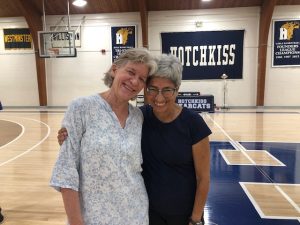
The first summer 2024 Tai Chi Retreat was held in Lakeville, Connecticut, at the Hotchkiss School from June 17 to 24. The beautifully landscaped campus of green lawns and enormous trees was the perfect setting for our internal work. However, the weather was very hot and humid, so little time was spent outdoors, which was too bad as the campus is beautiful.

Sixty-three of us gathered to do tai chi and qigong in the gym, squash courts, dining room, and hallways. We all started together in the morning with a session of qigong led by rotating teachers: Greg Woodson, Margaret Olmsted, Edna Brandt, Kate Mansfield, George Kormendi, Jonathan Stow, and Bob Etherington.

Then, everyone went to their respective Form classes, followed by a break or Push Hands classes. Afternoons included more Form work, Push Hands, the Eight Ways, and Sword Form. Many thanks to all who taught this summer: Jonathan Stow, Greg Woodson, Margaret Matsumoto, Margaret Olmsted, Bob Etherington, George Kormendi, Kate Mansfield, Edna Brandt, Anne Smyers, Vicki Shackford, Lee Felton, Susan Dunlap, Doug Hewell, John Doody, and Michael Tillman.

We welcomed and trained five students who became new beginning-level apprentices: Ben Wegner of Los Angeles, California, Mathew Choppe of Gainesville, Florida, Richard and Kimiko Tucker of Nashville, Tennessee, and Almaz Matta of Arlington, Virginia.

Additionally, we were delighted to offer Hawaiian Swimming this summer, which was expertly taught by Vicki Shackford and Michael Tillman, who helped people relax in the water and swim more efficiently. The class was much appreciated.

Everyone was thankful to all the teachers who contributed with their vast skill and knowledge banks. Many of us have been together for over 45 years, so there is a wealth of experience and wisdom that was happily shared. We recognized how fortunate our school is to be together 32 years and counting, since the death of Patrick Watson, founder of the Tai Chi Foundation.

The evening programs included a wonderful talk by Edna Brandt about Professor Cheng Man-ching and his paintings, an informative anatomy session by Bob Etherington, an insightful presentation on the Five Elements by Kate Mansfield, a taste of Push Hands by Margaret Matsumoto and Greg Woodson, and the film The Professor’s Journey West about Professor Cheng Man-ching.

Every meal offered an abundance of proteins, vegetables, salads, and vegan offerings with produce from the local farm. At first, there were no desserts, but we soon straightened that out and enjoyed chocolate pudding pie, flourless chocolate cake, carrot cake, and more. The dining room was filled with laughter and conversation as people renewed old friendships, made new friends, and shared their class experiences of the day with peers and teachers.

For the final day, we followed tradition by gathering for Treasure Chest to share our gratitude for the experience and all the teaching, organizing, and inspiration that went into the retreat. Our strong feelings of connection and joy put a sparkle in everyone’s eyes. For the last night, we all enjoyed entertainment from a few participants and a brilliantly funny skit from the new apprentices based on the Hokey Pokey. The party afterward, with snacks, sweets, and dancing, was a perfect release from all our hard work.

Many thanks to all who came and to the teachers who continue to teach both live and online. Please check the Tai Chi Foundation (TCF) website regularly for new opportunities for classes and study.

We hope to see you next year when we celebrate the big 5-0 anniversary of our school, the Tai Chi Foundation:  50 Years of Tai Chi Excellence!

Photos by Anna Teeples

Tai Chi Anti-Aging Benefits: Boosting Stem Cell Production

Tai chi, an ancient Chinese martial art, has long gained recognition for its many health benefits, including stress reduction, improved balance, increased flexibility, enhanced brain health, and more. Now, there may be yet another reason to adopt this art: recent research has drawn a fascinating correlation between tai chi practice and its potential anti-aging effects with regard to the body’s production of stem cells. Keep reading to learn more about this discipline and how its anti-aging exercises can benefit you.

CD34+ Cells and Aging

CD34+ cells are a specific type of anti-aging stem cell found in the bone marrow and peripheral (circulating) blood. These cells play a crucial role in maintaining and repairing various tissues in the body, including the skin, blood vessels, and immune system. As we age, the production and function of CD34+ cells tend to decline, leading to a gradual decline in the body’s regenerative capacity and an increased susceptibility to age-related diseases.

Tai Chi Boosts the Production of CD34+ Cells

Emerging studies have suggested a link between tai chi practice and the enhanced production of CD34+ cells, which can potentially help to counteract the aging process. One study found that Tai Chi intervention resulted in a significant increase in CD34+ cells in older adults who practiced it for over a year. This, along with other studies producing similar results, suggests that tai chi may have a positive impact on the body’s regenerative capacity and potentially slow down the aging process.

How It May Work

The exact process through which tai chi enhances CD34+ cell production is still being investigated. However, researchers have some plausible theories as to how this works:

  • Preventing the release of harmful hormones. Some believe that tai chi’s anti-aging benefits are related to stress reduction. The slow, flowing movements of tai chi, combined with deep breathing and mindfulness, create a mind-body connection that promotes relaxation, reduces stress, and improves overall well-being. This is important because chronic stress (and the release of stress hormones like cortisol) can accelerate the aging process and impair the body’s regenerative capabilities.
  • Improving circulation and tissue “nutrition.” Additionally, tai chi’s gentle and rhythmic movements help to increase blood flow, providing nourishment to the bone marrow and peripheral tissues. This enhanced blood circulation may contribute to the increased production and mobilization of CD34+ cells, aiding in tissue repair and rejuvenation.

Age Better With the Tai Chi Foundation

The Tai Chi Foundation (TCF) is a not-for-profit educational organization that promotes, funds, and teaches programs that enable people to learn tai chi chuan and embody its principles. Join us for a FREE Open House meeting to learn more about tai chi and qigong — and ways to get started with us!

Check out our online course offerings. Sign up for our newsletter for updates on upcoming classes and events.

Over 200 TCF-affiliated instructors teach tai chi classes in 30 cities worldwide. Find a class in your area, become a member, and support TCF in making the world a healthier and more mindful place today!


By Oliver Herzfeld

Tai Chi Foundation 2024


Photo by Pixabays


Navigating Tai Chi and Life with Cheng Man-ch’ing’s Zuo You Ming


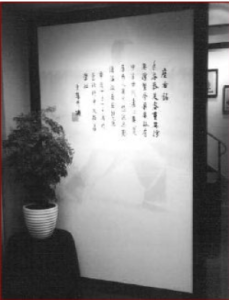
Within the rich tapestry of tai chi, Professor Cheng Man-ch’ing’s teachings shine brightly as guiding principles for both physical practice and spiritual growth. In Professor Cheng’s memorial hall in Taiwan, there hangs a photograph of him overlaid with his “zuo you ming” (i.e., motto or “words to live by”). The poem offers profound guidance on the core principles of tai chi and how to approach life with grace, humility, and poise.

In his article, “Zheng Manqing: The Memorial Hall and Legacy of the Master of Five Excellences in Taiwan,” published in Cheng Man-ch’ing and T’ai Chi: Echoes in the Hall of Happiness, Russ Mason translates the poem as follows1:


Allow the hands to be led lightly and humbly;

Allow the feet to be heavy, stepping with dignity.

Hang straight; hang straight! Be poised and upright.

Speak sparingly, directly, and with great care;

Be forgiving and generous; out of a centered heart, give back.

Be loyal, tolerant, and patient in your dealings;

Let your attitude toward others be temperate.

Repent, and correct your errors with silent contemplation.


Let’s explore the depth and significance of the first three lines of the poem.

  1. Allow the hands to be led lightly and humbly.

Professor Cheng’s instruction to allow the hands to be led lightly and humbly speaks to the first principle of tai chi, namely, all movements are initiated and directed by the dantian. The phrasing is very important. We are not instructed to “move our hands” with thought control. Instead, we “allow” our hands to be led by our dantian. The dantian, often understood as the body’s center of gravity, serves as the pivot point from which movement originates. By relinquishing thought control and ego and allowing our hands (and indeed our entire body) to be guided lightly and humbly by the dantian, we tap into the body’s innate wisdom, moving with effortless grace and precision. The reference to being “led lightly and humbly” speaks to the principle of cultivating receptivity and sensitivity, allowing the flow of energy to guide our movements rather than imposing force.

Moreover, this guidance extends beyond physical movement to encompass the journey of life itself. Just as our hands are led by the dantian, so too can we allow our actions to be guided by our deeper sense of intuition and wisdom, humbly acknowledging our connection to the greater flow of existence.

  1. Allow the feet to be heavy, stepping with dignity.

Professor Cheng’s instruction to allow our feet to be heavy and to step with dignity reminds us of the importance of groundedness and stability. In tai chi, each step is an opportunity to embody rootedness, nobility, and grace. Rootedness is essential for maintaining balance and power in movement. It is achieved through proper body alignment, relaxation, and allowing all weight (i.e., your own weight, the weight of your partner and the weight of any weapon or other object you are holding) to pass through you into the ground. By rooting our feet firmly into the ground, we anchor ourselves in the present moment, establishing a strong foundation from which to move with poise and confidence.

Furthermore, stepping with dignity reflects a mindful attitude of reverence towards life’s journey. Each step becomes a deliberate act of self-expression, honoring our inherent self-worth and the respect we have for other human beings, and reflecting a deep awareness of our path in life. Stepping with dignity implies a sense of purpose and self-respect. Through dignified stepping, we honor our journey and the precious gift of each and every moment of our lives.

  1. Hang straight; hang straight! Be poised and upright.

The third prescription, to hang straight, with our head suspended from above, encapsulates the essence of tai chi posture and alignment. Maintaining a straight spine and upright posture is not only essential for physical health, but also for mental and spiritual well-being. By allowing the head to float effortlessly atop the spine, we cultivate a sense of lightness and buoyancy in our movements. This intangible and lively energy, lifting the crown of the head, connects us to the limitless expanse of the heavens above (i.e., rooting up).

In tai chi philosophy, the spine is considered the axis of the body, connecting heaven and earth. By hanging straight, we align ourselves with the natural flow of energy, fostering harmony and balance within. Being poised and upright signifies inner strength and integrity, qualities that are cultivated through diligent practice, self-observation, and self-awareness.

Moreover, hanging straight with the head suspended from above signifies alignment with the natural order of the universe. It reminds us to remain open and receptive to the guidance of higher wisdom, allowing us to be uplifted by the unseen forces shaping our lives.

Professor Cheng’s “zuo you ming” alludes to the Chinese cosmology and Taoist concept of the Three Treasures (san cai): heaven (tian), human beings (ren), and earth (di). The dantian represents the center of our being and source of movement. Rooting our feet signifies our connection to the earth. Suspending the head connects us to heaven. By integrating these key tai chi principles, Professor Cheng offers profound advice for pursuing harmony and balance as we navigate our journey through life.


You can learn more about Professor Cheng’s teachings by exploring the diverse offerings of the Tai Chi Foundation (TCF). TCF provides live online courses, allowing you to participate in guided sessions from the comfort of your home. These virtual classes offer unique opportunities to connect with experienced instructors, ensuring that you receive personalized guidance and feedback. Additionally, the Tai Chi Foundation offers Teachable on-demand classes, providing a flexible and accessible way to learn at your own pace. Whether you’re a beginner or an experienced practitioner, these online resources offer a wealth of knowledge to enrich your tai chi journey. For those seeking a more hands-on experience, check out the regular course offerings of TCF’s affiliated local schools.

TCF is a not-for-profit educational organization that promotes, funds, and teaches programs that enable people to learn tai chi chuan and embody its principles.

TCF’s mission is to improve health, well-being, and awareness through the study, practice, and teaching of tai chi and qigong by an increasing number of people worldwide. Sign up for our newsletter to learn about our latest classes and events.

There are over 200 TCF-affiliated instructors teaching tai chi classes in 30 cities around the world. Find a class, become a member, and support TCF in making the world a healthier and more mindful place today.

By Oliver Herzfeld

1 Russ Mason’s photograph of Professor Cheng overlaid with his “zuo you ming” and Russ Mason’s translation are both used by permission.

© Tai Chi Foundation 2024


Embracing the Summer Fire Energy: Igniting Joy and Connection through Tai Chi and Qigong


As the sun climbs high in the sky, casting its golden rays upon the earth, I find myself enveloped in the radiant energy of summer. In the ancient wisdom of tai chi and qigong, summer is associated with the fire element, a time of love, joy, and the warmth of human connection. In these challenging times, when the world feels uncertain and divided, embracing the summer fire energy becomes more important than ever. It is a time to rekindle the fire within myself, to express happiness, move freely, and fully manifest my true being. Please join me on my journey as I explore the transformative power of summer fire energy through my practice of tai chi and qigong.

Summer is a season of abundance when nature bursts forth in full bloom, painting the world with vibrant colors and intoxicating scents. Similarly, within myself, the summer fire energy ignites a sense of joy and connection that brings me fully alive. For me, it is a time to laugh together, share moments of warmth and camaraderie, and feel equal and loved in the company of others.

In my own practice of tai chi and qigong, I have found that the movements and principles of this beautiful art enhance my appreciation of the summer fire energy. As I flow through the tai chi form, I sense a deep pleasure and vitality coursing through my energy channels (meridians), sinews, and blood vessels. As I practice qigong, the movements restore my energy and help me cultivate a calm, grounded state as a natural way of being. Each tai chi and qigong movement becomes a celebration of life, a display of energy and connection with the world around me.

But summer fire energy is not just about external expressions of joy and connection—it is also about igniting the fire within ourselves. It is a time to tap into our inner reservoirs of strength and passion, to allow our true being to shine brightly in the world. What brings out our laughter? What moves us to dance with abandon? These are the questions we must all ask ourselves as we seek to embody the essence of summer fire energy.

For me, practicing tai chi and qigong in the summertime is a powerful way to reconnect with my inner fire. With each breath, each movement, I feel myself rooting down, rooting up, opening and expanding, reaching towards the highest manifestation of my true self. Tai chi and qigong teach us to flow with the natural rhythms of life, to embrace change and transformation, and let our inner light shine forth with radiant intensity.

Like the flickering flames of a fire reaching towards the heavens, summer fire energy urges me to ascend to higher realms of consciousness and being. It calls me to transcend my limitations, to break free from my shackles of fear and doubt, and to embrace the boundless potential that lies within me.

As we practice tai chi and qigong, we learn to harness the power of fire energy, channeling its transformative force into every aspect of our lives. We become more attuned to the subtle rhythms of nature, more open to the flow of energy within and around us, and more alive to the infinite possibilities that exist in every moment.

In the midst of life’s challenges and uncertainties, let us not forget the transformative power of summer fire energy. Let us connect with one another in the spirit of happiness and love. Let us rekindle the fire within ourselves, allowing our true being to shine forth with radiant brilliance. And let us ascend to the highest realms of consciousness and being, embracing the boundless potential that lies within us all, and experiencing moments of unity with something greater than ourselves. As we practice tai chi and qigong, let us embody the essence of summer fire energy, igniting the flame of joy and connection in our hearts and in the world around us.

You can learn more about tai chi and qigong by exploring the diverse offerings of the Tai Chi Foundation (TCF). TCF provides a free seasonal tuning for the summer fire energy. Click here to learn more. TCF also provides live online courses, allowing you to participate in guided sessions from the comfort of your home. These virtual classes offer unique opportunities to connect with experienced instructors, ensuring that you receive personalized guidance and feedback, as well as Teachable on-demand classes, providing a flexible and accessible way to learn at your own pace. Whether you’re a beginner or an experienced practitioner, these online resources offer a wealth of knowledge to enrich your tai chi and qigong journey. For those seeking a more hands-on experience, check out the regular course offerings of TCF’s affiliated local schools.

TCF is a not-for-profit educational organization that promotes, funds, and teaches programs that enable people to learn tai chi chuan and embody its principles.

TCF’s mission is to improve health, well-being, and awareness through the study, practice, and teaching of tai chi and qigong by an increasing number of people worldwide. Sign up for our newsletter for updates on upcoming classes and events.

There are over 200 TCF-affiliated instructors teaching tai chi classes in 30 cities around the world. Find a class, become a member, and support TCF in making the world a healthier and more mindful place today.

By Oliver Herzfeld

© Tai Chi Foundation 2024

Photography: Bob Clark on Pexels

The Hidden Gem of Tai Chi

Tai chi practice is a gift we can give ourselves and share with others through our relaxed presence. It brings relaxation, joy, and a boost to our vitality. It works through conscious movement and, following basic principles, offers a way to ground ourselves, eliminating unintentional stressful habits and body dynamics that can cause us harm. It is gentle, and through practice can return our bodies to a natural open alignment with gravity. An added benefit is, while studying with others, it can offer a sense of community and connection as we learn to move together in harmony.

After we have begun to embody its core principles and alignment, tai chi chuan (the martial art) goes further to offer a practice that truly is the hidden gem. It is the partner practice of Push Hands, also called Sensing Hands. This practice gives us a physical way to maintain our relaxation even under the emotional pressure of close contact and find the same harmonious connection as in the form practice. We learn how to connect without freezing, pushing, or running. Sensing Hands also presents experiential and visible feedback on our ego tendencies and habits.

Cooperative practice can soothe us into a relaxed response to the world. The benefits of cooperation and mutual support far surpass what can be achieved in a competitive atmosphere. In cooperative practice we learn empathy, compassion and understanding. Fostering a cooperative atmosphere in partner work requires clear intention based on an understanding that we will each learn and embody more when we embrace supporting each other through our challenges. We can come to see each other as helpful mirrors, often showing us exactly what we get to discover and change in ourselves.

The intention we need is one of willingness to participate in an activity which will promote change in our point of view and our physical actions. We also get to establish an agreement with our partners to support each other in our learning, even when it is difficult. This is essential. Although these skills can be learned in a more old-school competitive environment, that style is not suited to everyone. Working together is something that we all can achieve.

First, we agree to support each other, gently discovering our own and our partners’ imbalanced overreactions. The practice involves employing the fundamental principles of Tai Chi (Supreme Ultimate Principle):

  • Dantian awareness
  • Relaxed alignment
  • Rooted relaxation
  • Full body action while in connection
  • Constant free mobility

While practicing, we will deepen our understanding and embodiment of the basics as we learn to respond from a full body awareness. The key principle is to discover that we can “get out of our heads” and trust the knowledge in our body. We learn to work from dantian awareness which guides our body to respond as a whole while maintaining a relaxed grounding.

These basics are brought forward from our solo and group practice where we gradually awaken the dantian awareness that, among other things, gives us the sense of our whole body as one.

We are no longer racing through our thoughts trying to remember all the parts of the whole. We gradually let go of strategizing in favor of simple present awareness and response.

How do you do it? First you set your intention to be patient with yourself. Recognize that although you may be able to conceptualize how, you will need to experience how. That means leaving behind the ideas and instructions while you focus in the dantian to feel from the inside—rather than think about it from the outside.

You can use the following points to conduct an inquiry into how many of the basics are in your body. Remember, patience is key and self judgment is not helpful. These basics don’t just show up magically but require good old-fashioned personal effort, continued attention, and practice.

  • Learn, by practicing how to find your root. This means softening your legs while aligning the bones to transmit your weight into the ground. You don’t have to hold yourself up. When rooting clearly happens down through one foot, the other foot feels empty and free. There are phases here; root exists in any weight distribution; but “single-weighting” is the clearest start. Single-weighting is also essential for free movement of the feet.
  • Your relaxation will happen most easily from the top down. It feels like emptying your upper body of heaviness. Let your shoulders, arms and hands relax. Feel the weight of your arms traveling down through your body to the ground rather than outside your body.
  • Make sure that your body is untwisted. This takes a while, since any habitual postures we hold in our body, even unintentionally, become hard to perceive. You will begin to feel freer and emptier, especially when you relax all around and within the pelvic cavity and loosen your hips so they are free to move. To do this, you soften the legs (see point 1).
  • You will find that you habitually lean on yourself, often when feeling tired. Your challenge is to embrace the openness that comes from “unwinding” and standing with relaxed alignment.
  • When it comes to moving your legs, practice moving from the dantian. This means moving the center of your body to move the feet. Release the legs so that they follow the movement of the center of your body (dantian) and can travel with emptiness, free of stiffness.
  • Simultaneously, we learn to allow the arms to be moved in this same fashion, from the center. Although we have and constantly utilize muscular control of our arms independently, our challenge is to let them be moved with only soft support and guidance from the muscles. In other words, we learn to move our body to move our hands. I have found this much harder to imagine than to accomplish. This is something to play with in your practice, but also during your daily life. When combined with the previous steps, it becomes much freer and more precise. You learn to let go of muscular force.
  • With all the forms we can discover the subtleties of momentum in our movements, all the while maintaining our rooted connection to the ground. We discover that fluid balanced movement is based on our vertical alignment rather than only horizontal movement. The feeling is like moving down instead of horizontally. Or like keeping our weight below the floor while we move with complete freedom and lightness above.

The preceding practices prepare us for partner work. When we work with a partner it is essential that we bring all these skills with us. They need to be embodied, because the stress of contact may very well blank our minds with agitation that can completely unground us. Our challenge is to remain relaxed, connected, and grounded.

  • We must first deepen and stabilize the multi-faceted awareness available from the dantian. We don’t have time to remember our body intellectually. We get to be awake, in the moment, and able to respond in balance to what is happening in real time.
  • We can benefit from starting with a moment of recognition, essence to essence, before engaging in Push Hands practice. It can help us release emotional stress that may be present and allow us to confirm our intention for mutual trust and cooperative learning.
  • We learn how to follow the movements of our partner, while maintaining our awareness and balance.
  • We learn how to move our point(s) of contact with our whole body center (dantian), letting go of independent thought-based arm movements in favor of dantian directed full body action.
  • These skills can be developed by practicing the “butterfly touch sensing hands” exercise.
  • When we sufficiently embody these skills, we change to a different level of contact using the “4-ounce touch.” We continue with single hand exercises and eventually change to using two hands and more points of contact, while employing the same basic movement skills as before. Here we begin to discover that we can ground the pressure of our partner using only 4-ounce contact through the same alignment we have learned to ground and relax our own weight in movement.
  • We further develop the movement skills necessary to maintain substantial contact while redirecting the incoming force away from our center, without introducing force of our own.
  • We begin to notice counterproductive tensions in both ourselves and our partners. This is a key opportunity where we can use our intention to support and help our partner in this fascinating discovery of how to relax. With a softness of spirit and a gentle touch, it becomes easy to help your partner notice their tension and, with patience, for us to recognize our own.

Push Hands or Sensing Hands practice is a key part of what has been called “self-cultivation” in the world of tai chi. The essential aspect is to cultivate a non-verbal, non-judgmental awareness available from the dantian. Awakening and stabilizing dantian awareness becomes the center of our tai chi practice. It is our physical access to a silent witness that supports us in our growth, our ability to objectively see ourselves, to make necessary changes, and to promote harmony in our relations with everyone we contact.

Thank you for your attention.

With love and respect,

– Greg Woodson, April 2024

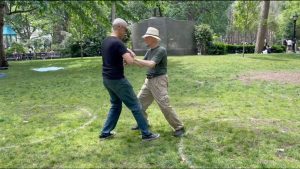
Greg playing Push Hands with Ken Van Sickle in May of 2021

Acknowledgements

Thank you to:

Patrick Watson for his patient teaching, allowing for discovery, and his brilliant, embodied demonstrations of Principle. He pointed out that we can be rooted in almost any position, but that alignment is the way to learn it.

Oscar Ichazo and the Integral Philosophy of his Arica School® of Knowledge which teaches extensive practice of Kath (dantian) awareness as the basis for grounding across all Realms to support the process of ego-reduction and as the basis for experiencing the Higher States of Consciousness.

Dr. Yang Yang for pointing out the simple possibility of relaxing and rooting while standing, sitting or lying down, and demonstrating that root manifests in the alternate foot positions used in Chen style tai chi.

Ken Van Sickle who helped me to free my mind of interpretations of how I thought things should be done.


© Tai Chi Foundation 2024